
RewireXAI
Landfall
An island of story-wrapped therapeutic tools — CBT, DBT, EMDR pacing, parts work, grounding — carried by a five-act story that hands you back your own name.
$19.99/moExplore →

A clinical workspace you install on your own computer, and three story worlds that carry the work home between sessions. Built in a live practice by a licensed counselor with twenty-five years and more than 25,000 clients.
Clinical machines designed to take over your heart, not the world.
Where the record lives
There is no company in the middle.
The Lighthouse is not a login. It is an application that runs on your Mac or PC. The session is heard on that machine, the note is drafted there by a model that runs there, and the record is stored there. Which means there is no agreement to sign with us, and no third party whose breach could become yours. That is not a setting you switch on — it is the only way it is built.
Who’s asking
The same island, read two different ways. Nothing here is hidden behind the other door.
I see clients
$49.99 /month, introductory and locked at the price you join on
I’m here for me
$19.99 /month each · anyone can subscribe
The Lighthouse
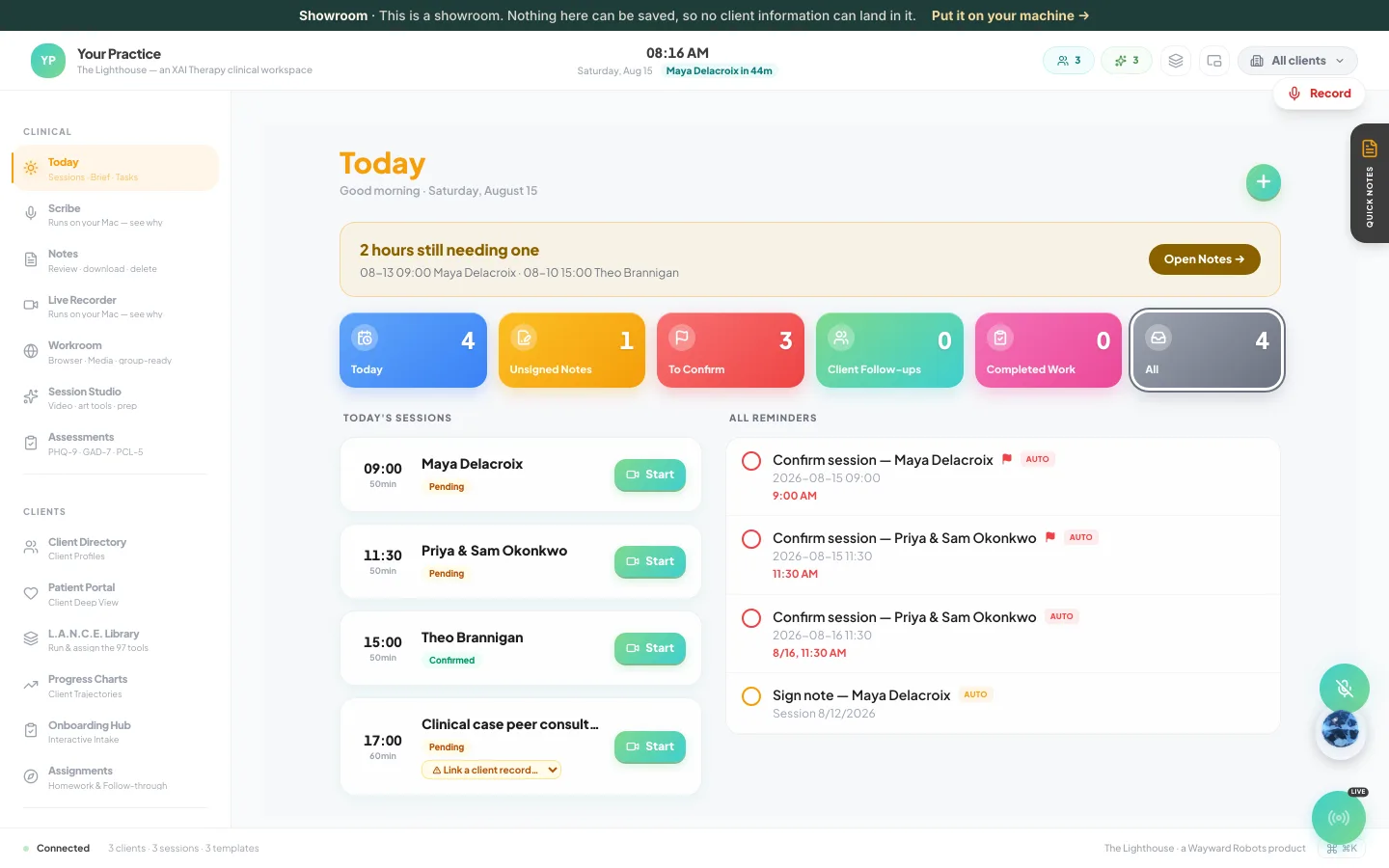
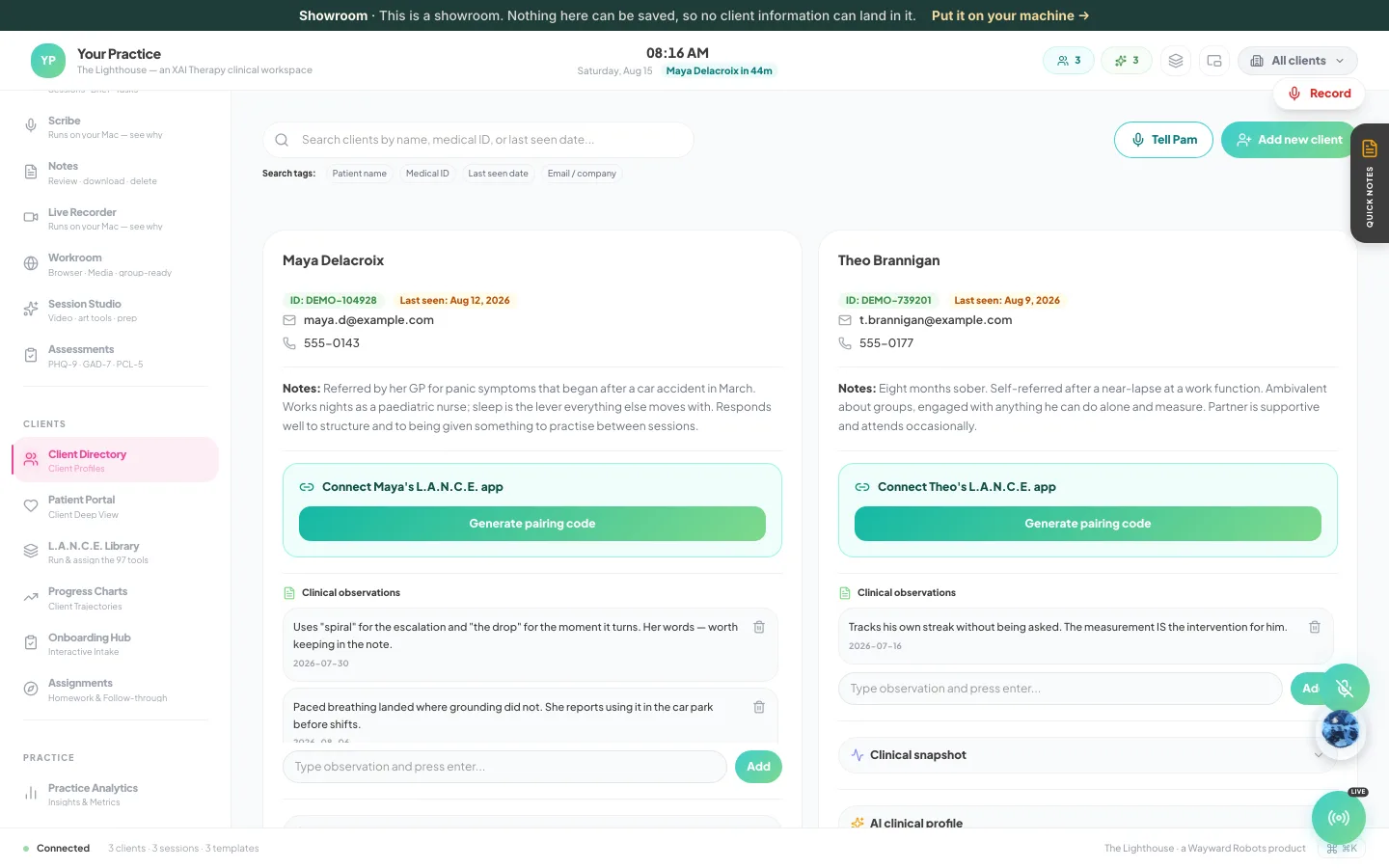
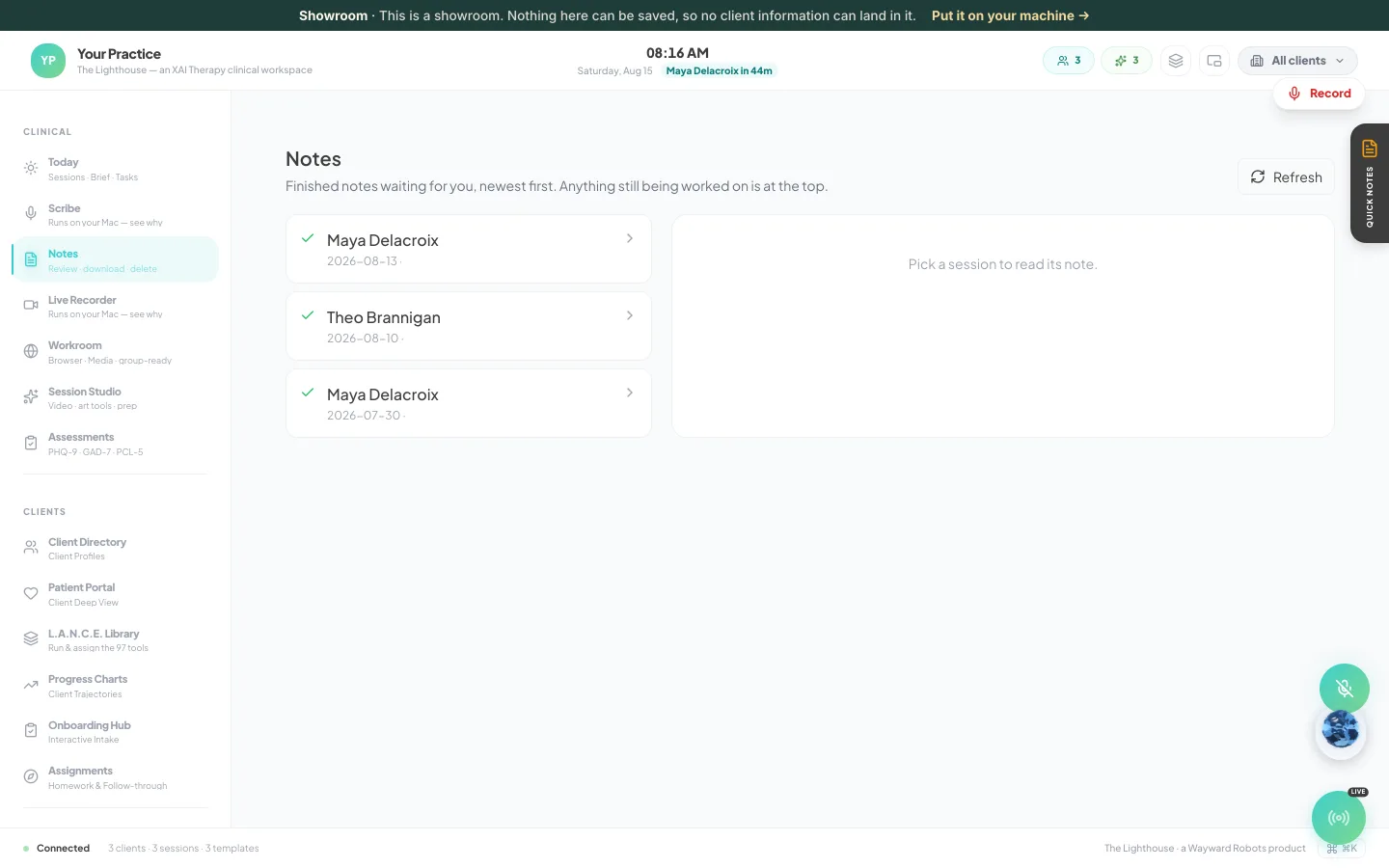
Not a mock-up and not a promise — the working software, showing a made-up practice you can walk through right now without a card, a signup, or anything to fill in.
The worlds
Wrap them in a world worth returning to and they find the one they needed. A therapist sees forty-five minutes of a week that holds 10,080 — these are for the rest of it.
RewireXAI
An island of story-wrapped therapeutic tools — CBT, DBT, EMDR pacing, parts work, grounding — carried by a five-act story that hands you back your own name.

RehabitXAI
Recovery as a crossing — a real curriculum carried by a crew of copper robots who were each almost thrown away. It opens as a painted film, told by Buddy.

ReconnectXAI
Couples and families shipwrecked on the same shore, where nothing important works alone. Twenty campfire games, a walkable island, and a full-ring origin film told by Skip.
Assign a tool on Tuesday and know by Tuesday night. One code pairs a client in seconds, either side can disconnect at any time, and the client’s world survives whole on their own device. What a couple says to each other at Driftwood’s waterfall never crosses the bridge at all — by design, and asserted by our test suite.
XAI Therapy™ — the standard
Wayward Robots is the studio. XAI Therapy is the standard everything here is built to — a discipline for keeping AI’s role in the room small, visible, and answerable to a human.
Take an opaque model, let it listen, then ask it to explain itself afterwards.
The research is clear that those explanations are plausible stories, not faithful
readouts of what the model actually did. The explanation is bolted on, and it is not true.
Never build the black box. The tools generate structured, framework-tagged data by
design — a thought record natively holds the situation, the automatic thought, the
distortion named, the evidence, the reframe, and the belief rating before and after.
The explanation is the native shape of the data.
No “proprietary” curtain. The client sees what the clinician sees about them. Where AI helped build the products themselves, we say so — out loud, in the apps.
A belief rating that dropped. A distortion, named. An avoidance pattern with dates on it. Readable in seconds, actionable in session, no decoding required.
Evidence, plus the named clinical framework, plus a human who decides. Never a story pried out of a model after the fact.
Not prognosis. Not a billing code. Not “the client appears anxious.” Asked about suicidal ideation on a transcript where it was raised and explicitly denied, a model returned nothing at all — and “denied” is a documented assessment, while nothing is a hole in the record. So the model is never asked. Your standing lines are placed into the note afterwards, where nothing it writes can reach them. Anything drafted that is a judgement rather than an observation arrives marked unconfirmed, and the note cannot be signed until a human has read it and accepted it. That refusal lives in the software, not in a policy document.

One island. Three eras. One law.
One man built tools so his boy could live. The tools outlived their purpose — and went looking for more people to help.
Gullhaven, 1929. A boy nobody kept builds a boat from driftwood and a flour sack and sails for an island that shouldn’t exist. He fails to fix the sun, so he builds ninety-seven tools instead — one for each friend’s particular sadness. Everything here grows out of that one crossing. Your clients don’t get a toolbox; they get a world with a memory.
The store
An XAI Clinical Workspace
$49.99 /month
Landfall · the voyage · Driftwood
$19.99 /month each
30 days, full refund, no questions asked — write to ask@lancenabers.com and I send the money back. That is the whole guarantee, and it is the same sentence on every page that makes it.
Every world. One law.
These products are practitioner-run. You configure every safety surface for your own jurisdiction and your own clients — the worlds carry your plan, never a hard-coded one. We are used in more than one country, and a number written for one place does not answer in another. We make no compliance claim we have not earned, and we say exactly what each product is and isn’t.